
Guide
Best Squid Jig Colours Australia
Use natural prawn, olive or silver squid jigs in clear water; orange, red foil, glow or strong contrast in dirty water; and glow with a dark silhouette at night.
Publisher disclosure: SquidFishing.com.au is the educational publishing site of RUI Fishing Tackles, edited by founder Rui Tang. The RUI examples link to our store, eging.com.au; the colour principles apply beyond our range. Catalogue features and angler observations are not controlled proof that one colour catches more squid.
What squid jig colour should you use in Australia?
Use a natural prawn, olive, brown or silver jig in clear bright water. Move to orange, red foil, pink, glow or stronger contrast when the water is stained. At dawn, dusk, night or under pier lights, start with glow plus a dark silhouette. If squid follow without grabbing, change one step rather than replacing the whole setup.
If you spend enough time eging around Australia, you stop asking, “What is the one best squid jig colour?” and start asking, “What colour makes the most sense for the water in front of me right now?”
That shift matters. Jig colour is not just a cosmetic choice. In practical Australian fishing, colour changes how visible the jig looks, how natural it appears on the pause, and how easy it is for squid to track it through changing light, dirty water or broken structure.
If you are still choosing your base setup first, begin with the main guide on the best squid jig in Australia. For the bigger method behind colour selection, use the Eging Australia guide. If you also want to match colour to sink behaviour, pair this with the Squid Jig Sinking Rate Guide Australia.
If you want a faster pre-session decision, open the free Squid Jig Colour Selector first, then use the chart below when you want the reasoning behind the recommendation.
Once you have picked the right colour family for the water, shop the core RUI squid jig range (2.5-4.0) to match that clear-water, dirty-water, glow or UV decision. Selected 1.8 and 2.0 models extend the full range for shallow, calm and finesse presentations.
Which colours actually sell most in Australia? Across close to one million RUI squid jigs sold through online and wholesale channels, the runaway number one is the red-head glow (KR56). This guide is about matching colour to the water in front of you; if you want the buyer’s-eye view instead, see the full RUI squid jig colour sales report — the top ten colours ranked across close to one million sales.
Quick squid jig colour chart for Australia
Use this quick chart when you need a starting colour before the first cast. It is designed for Australian eging where water clarity, light level, bottom colour and squid behaviour can change in the same session.
| Condition | Colour starting point | Specific RUI example and reason | Next adjustment |
|---|---|---|---|
| Clear bright water over sand | Natural baitfish or silver | GS05 Mullet Grey Silver: mullet cloth and plain silver foil, without UV, glow or rattle | Choose 2.5 for shallow water or 3.0 for general use |
| Clear water with cloud or late afternoon light | Pink with silver flash or UV detail | AK10 Aurora UV Pink Silver Belly: pink, reflective insert and UV response while ambient light remains | Add charged glow if the light falls away |
| Lightly stained water where light still penetrates | Orange or warmer flash | AK12 Aurora UV Orange Gold Belly: orange profile with gold flash and UV response | For very low visibility, try a glow option instead of relying on UV |
| Night, pier shadows or dirty water | Charged glow or contrast | KR103 New Glow Banana: chartreuse body and retained glow after charging | Compare against a darker silhouette if follows do not become takes |
| Shallow weed with a larger profile | Choose colour, then slow the fall | AK18 3.5 Slow Sinking: labelled 19g and 5.0–5.5 sec/m, distinct from standard 3.5 | Use the sink-rate guide; do not solve a depth problem only by changing colour |
Model features and variants were checked against RUI product pages on 17 September 2026. Follow each model link for current price and stock. UV response needs available ultraviolet light; glow retains a charge and fades with time. Neither finish guarantees a catch.
What colour actually changes in Australian eging
Colour does more than make a jig look pretty. In practice it changes how easy the squid can find it, how natural or aggressive the presentation feels, how the lure sits against the bottom below, and how well it holds visibility as the light drops.
Which is why the same colour that fishes brilliantly in clear afternoon water can completely disappear once tide pushes dirty water in, or once the sun drops.
Before changing every part of the rig, separate the four jobs colour is doing:
- Water clarity: clean water lets squid inspect a natural jig; dirty water makes visibility more important.
- Light level: dawn, dusk and night push you toward glow, contrast and silhouette.
- Bottom colour: pale sand, dark weed and broken reef all change how strongly a jig stands out.
- Squid behaviour: follows without grabs usually mean the colour is close, but the final trigger is wrong.
Clear water usually rewards natural colours
In clean water, especially over sand patches, ribbon weed and shallow reef, squid often get a long look at the jig. That is usually where natural colours make the most sense.
Natural cloth colours
Natural prawn, olive, brown, silver-backed and lightly tinted baitfish patterns stay useful because they do not force the issue. In clean water, squid can inspect the jig properly, so a more believable profile often beats a loud one. A natural catalogue example is the RUI GS05 Mullet Grey Silver Natural Squid Jig, listed in sizes 2.5, 3.0, 3.5 and 4.0.
Natural colours make the most sense when:
- the water is clean and bright
- the squid are following but not fully committing
- you are fishing over pale sand, broken reef or clean weed edges
- the session is calm enough that the jig already looks easy to track
Soft pink is often more natural than anglers think
Pink gets treated like a “bright” option, but in practice a softer pink with a translucent or prawn-style finish can still fish very naturally. That is one reason pink remains such a strong all-round colour in Australian eging. The RUI AK10 Aurora UV Pink Silver Belly Squid Jig is a catalogue pink and silver-belly example listed in sizes 2.5, 3.0 and 3.5. For a soft-pink starting option, browse RUI’s pink squid jigs.
Dirty water usually rewards louder colours
Once the water dirties up, the main job changes from realism to visibility.
Orange and stronger contrast colours
Orange is one of the first colours worth reaching for when swell, rain, tide movement or boat wash has knocked the clarity around. It helps the jig stand out more quickly, especially over darker bottom or stirred-up weed. A catalogue orange and gold-belly example is the RUI AK12 Aurora UV Orange Gold Belly Squid Jig, listed in sizes 2.5, 3.0 and 3.5.
Red foil and warmer flash patterns
Red foil style jigs can be very handy when you want more flash and contrast without stepping straight into the brightest glow profile in the box. They often sit in a useful middle ground between natural and loud. The RUI GS06 Red Tiger Red Foil Squid Jig is an explicit red-foil catalogue example listed in sizes 2.5, 3.0, 3.5 and 4.0.
Red is only one foil, though. Silver, gold and rainbow each reflect differently under the cloth, and the squid jig foil colours guide breaks down which foil to reach for by light and water clarity — the layer beneath the colour you’ve just chosen.
Loud colours are often the right answer in dirty water
A lot of anglers overthink this part. If the water is genuinely dirty, a subtle natural jig can simply disappear too easily. This is one of those moments where a louder jig is not overdoing it. It is just easier for the squid to find.
Low light and night squid jig colours
Low light is not exactly the same as dirty water. At dawn, dusk and after dark, the colour question becomes more about outline, contrast and retained visibility.
Glow colours
Glow is popular for a reason. Around piers, harbour walls and evening sessions, glow cloths help squid track the jig more cleanly when available light falls away. A catalogue glow example is the RUI KR103 New Glow Banana Chartreuse Squid Jig, listed in sizes 2.5, 3.0, 3.5 and 4.0 plus a 3.5 Slow Sinking variant.
Dark-backed colours
Some darker-backed jigs fish better than people expect in low light because they create a stronger silhouette. That outline can matter more than a purely bright daytime finish. The RUI KR100 Special Black Foil Deep Blue Squid Jig is a black-foil and deep-blue catalogue example listed in sizes 2.5, 3.0, 3.5 and 4.0 plus a 3.5 Slow Sinking variant.
Pink and orange still stay relevant
Pink and orange do not stop working when the sun drops. They often remain useful because they are easier to pick up than muted natural tones, while still looking fishable rather than overly harsh.
If you are fishing elevated structure after dark, it is also worth reading the best squid gaff in Australia guide.
Underestimated colour combinations that deserve more time in the water
A lot of anglers rotate through the obvious choices but skip some of the combinations that quietly fish very well in Australian conditions.
Natural top with glow belly
This is one of the most underrated crossover options. It still looks reasonably natural in cleaner water, but the glow belly adds enough extra visibility to keep the jig readable when the light drops.
Olive or brown with pink highlights
These mixed natural-warm patterns can be excellent when straight naturals feel too dull but full orange feels too pushy. They often work well around weed beds where you still want a believable prawn shape with a little more life.
Red foil with neutral cloth
Red foil gets written off as niche, but in mixed clarity or over darker bottom it can be a very useful change-up colour. It gives you a warmer flash without going fully loud.
Dark-backed glow combinations
A darker back paired with glow or stronger internal contrast can make a lot of sense in low light because you get both silhouette and visibility. That is one of those combinations that often looks better in the water than it does in the packet.
UV and glow do different jobs in the water
UV and glow get used interchangeably, but they are doing different things in the water.
Watch the difference on one jig
The clip below is a single squid jig in a marine aquarium, filmed in three lighting states without changing the jig or the camera: ordinary white room light, then a 365nm UV torch, then darkness with the room lights switched off.
Filmed by Rui Tang in a marine aquarium. White light 0:00–0:06, 365nm UV torch 0:06–0:16, room lights off 0:16–0:25. The clip is edited from one continuous test; the full uncut 56-second recording is published alongside it.
Three things are worth watching for:
- Under white light the jig reads as a pale, natural body. This is the version you judge in the shop, and it is the version squid see on a bright day in clear water.
- Under the 365nm UV torch the body lifts to a bright blue-white and the head band reads hard green. Nothing about the jig changed — the light did. Move the torch away and the effect goes with it.
- With the lights off only the charged areas stay visible: the head band, the back stripes and the tail. They start bright and visibly dim across the clip. The rest of the jig is not visible at all.
That is the whole distinction. UV is a response to light that is present. Glow is a charge the jig carries after the light is gone. A jig can do both, but it does them at different times, and one does not substitute for the other. A UV-heavy jig with no glow gives you nothing once the light drops away; a glow jig that has not been charged is just a dark jig.
What the clip does not show: an aquarium is not the ocean, and a 365nm torch held close is far stronger ultraviolet than what reaches a jig several metres down in Australian coastal water. Treat it as a demonstration of the mechanism, not as evidence about catch rates.
Glow is for retained visibility in low light
Glow helps when available light is low and you need the jig to stay easy to track. Dawn, dusk, night fishing, pier lights and dark weather all make glow more relevant.
UV is more about presence and response
UV is usually less about the jig shining like a torch and more about giving the lure an extra visual trigger. In practice, UV can still be useful in daylight, especially in cleaner water where the squid are inspecting closely and you want the jig to carry a bit more life.
A simple way to think about it
- use glow when you are trying to hold visibility in low light or dirty water
- use UV when you still have light, but want the jig to read with more presence or contrast
- use UV plus glow when conditions sit in the middle and you want coverage across both jobs
Clear water natural versus dirty water loud
If you want the simplest rule in this whole guide, it is this:
- clear water usually pushes you toward natural
- dirty water usually pushes you toward loud
That does not mean natural can never work in dirty water or loud colours can never work in clean water. It just means your starting point should match visibility.
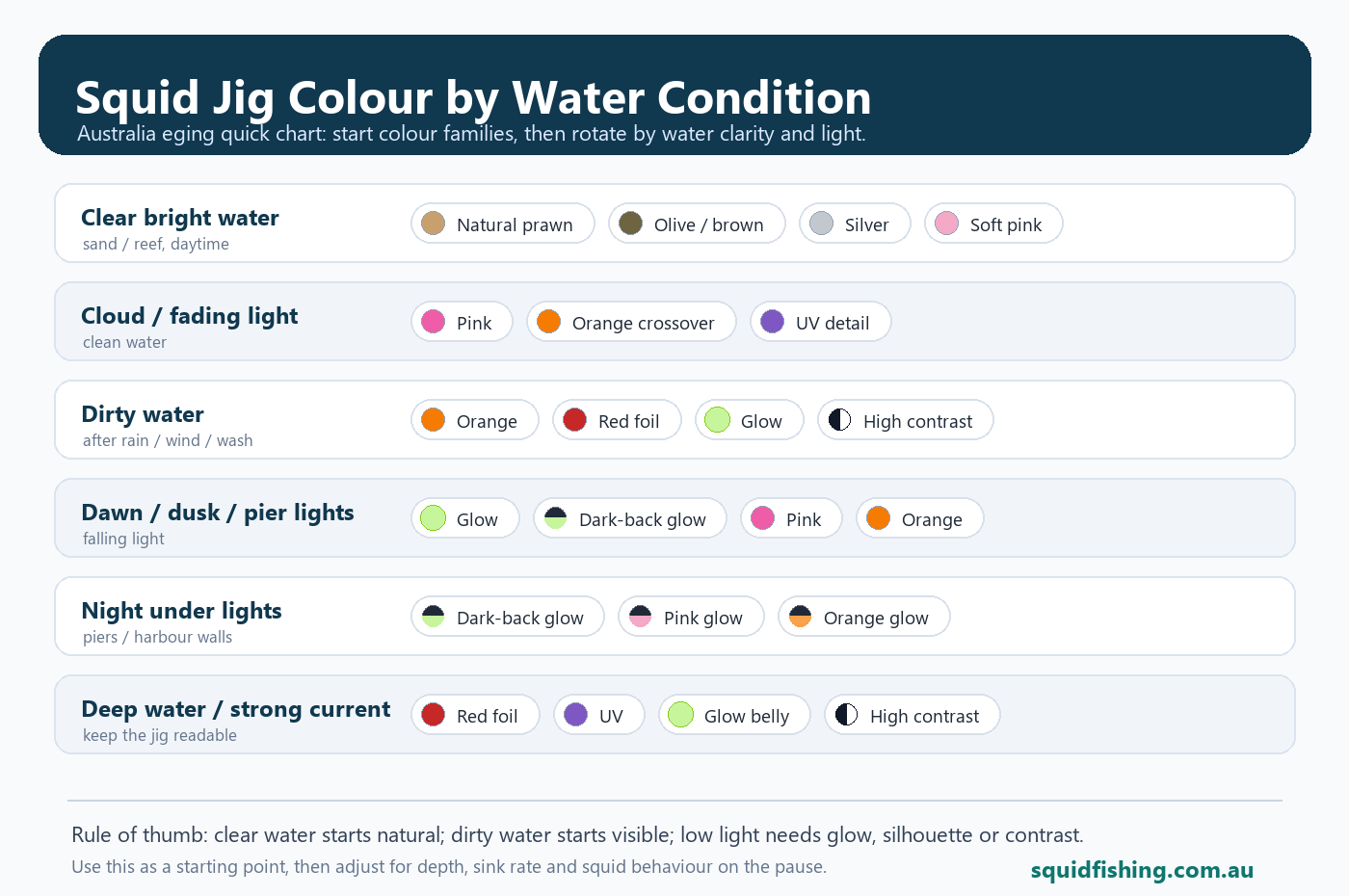
Squid jig colour by water condition
Use this as a starting grid, then adjust for depth, sink rate and how the squid respond on the pause. If the water, wind or light is changing quickly, also compare the squid fishing weather guide and the how to read water for squid fishing guide.
The following grid is a set of practical starting options, not a catch-rate ranking. Sales data records buying choices; it does not isolate water clarity, angler skill or retrieve, so it cannot prove which colour performs best in a particular condition.
| Australian condition | Start with | Why it works | Change if |
|---|---|---|---|
| Clear bright water over sand or reef | Natural prawn, olive, brown, silver or soft pink | Squid can inspect the jig properly, so a believable profile is less likely to look forced | Squid follow but do not grab; move to soft pink or UV detail |
| Clean water with cloud or fading light | Pink, orange-natural crossover, UV detail | Adds visibility without becoming too loud too early | Light drops further; add glow belly or stronger contrast |
| Dirty water after rain, wind or boat wash | Orange, glow, red foil, high contrast | The jig needs to be found before it can look natural | Squid are short-striking; slow the sink or reduce the profile |
| Dawn, dusk and pier lights | Glow, dark-backed glow, pink, orange | Outline and retained visibility matter more as available light falls | Squid inspect but avoid; try darker silhouette or natural-glow crossover |
| Dark weed beds or broken bottom | Orange, red foil, warm contrast, UV detail | Stronger colour separates the jig from the bottom | Water clears; rotate back to natural or soft pink |
| Clear water but shy squid | Soft pink, translucent prawn, natural with UV detail | Adds a small trigger without turning the whole jig loud | If follows continue, slow the retrieve and reduce sink speed |
| Night fishing under strong lights | Dark-backed glow, pink glow, orange glow | Glow keeps the jig readable while the dark back creates outline | If squid bump without holding, pause longer and reduce rod lifts |
| Deeper water or stronger current | High contrast, red foil, UV or glow belly | A stronger signal helps the jig stay readable as depth increases | Pair colour with a heavier or faster sinking jig |
If you already know the water condition you are trying to cover, go straight to eging.com.au’s shop squid jigs by water condition page and match clear water, dirty water, low light or night fishing to the right RUI colour family.
Start natural in clear water
When the water is clean, start with natural prawn, olive, brown, silver-backed or soft pink.
Start louder in dirty water
When visibility drops, begin with orange, glow, red foil or stronger high-contrast combinations.
Rotate faster when conditions change
If tide, wind or cloud cover is shifting the session, colour should be one of the first things you change. It is usually faster to rotate colour than to completely rethink the whole setup.
When should you change squid jig colour?
Current light, wind and water changes can all shift how visible or natural a jig looks, which is why it helps to check the Eging Tactical Radar before you commit to one colour plan.
Changing colour makes the most sense when:
- follows increase but grabs stop
- the water clarity changes with tide or wind
- cloud cover drops the light level
- you move from pale sand to darker weed or reef
- you shift from daytime fishing into dusk or night
The common mistake is waiting too long. A quick colour rotation is often the easiest adjustment available.
A practical Australian colour rotation
If you want a simple system that covers most sessions, use this:
Start natural
Begin with a natural prawn, olive or baitfish tone in clean water.
Move to pink
If squid are present but not fully committing, pink is often the next logical step because it adds visibility without becoming too forceful.
Move to orange, red foil or stronger contrast
If the water gets dirtier or the bottom gets darker, stronger contrast usually deserves a proper run.
Finish with glow or a darker silhouette
For low light and night fishing, glow or strong silhouette jigs should already be in your rotation, not buried at the bottom of the bag.
What colours should beginners actually carry?
You do not need a giant tackle wallet to cover Australian conditions. A smarter starting set looks like this:
- one natural prawn or baitfish colour
- one softer pink
- one orange or stronger contrast colour
- one glow or low-light option
- one crossover colour with either UV detail or a glow belly
That gives you enough range to fish clear water, dirty water, low light and night sessions without overcomplicating every decision.
If you also need to match colour to size and depth control, read the full squid jig size guide.
For night sessions, also compare this colour rotation with the night squid fishing guide so glow and silhouette choices match the pier lights, shadow edges and soft takes you are likely to see.
Squid jig colour FAQ
Does squid jig colour really matter?
Yes, but visibility comes first. In clear water a natural, believable colour usually wins; in dirty water a louder colour helps the squid find the jig at all; in low light, glow plus a dark back keeps an outline. Get the jig seen first, then make it look real.
What is the best squid jig colour for clear water?
Start natural - prawn, olive, brown, silver or soft pink. Clear water lets squid inspect the jig, so a natural profile is a practical starting point, not a guaranteed advantage. If they follow but won’t grab, compare pink or a UV-detail jig.
What colour squid jig works best in dirty water after rain?
Go louder: orange, red foil, high contrast or glow. After rain or wind the squid has to find the jig before it can judge it, so visibility beats realism. If they short-strike, slow the sink or drop to a smaller profile.
What is the best squid jig colour for night fishing?
Dark-backed glow, plus pink glow or orange glow. Glow keeps the jig readable in the dark while the dark back creates a clear silhouette under pier lights. If squid bump without holding, pause longer between rod lifts.
Do UV and glow squid jigs do the same thing?
No. Glow retains visible light after charging and fades with time. UV-responsive finishes need available ultraviolet light; they do not store a visible glow for darkness. Neither finish guarantees a stronger feeding response.
What squid jig colours should a beginner start with?
Four cover most Australian sessions: one natural/prawn, one soft pink, one orange or red foil, and one glow or dark-backed glow. That lets you rotate from natural to pink to orange to glow as light and water change.
How often should you change squid jig colour?
Change when the situation changes, not every cast. If squid follow but won’t commit after a few casts, shift one step, such as natural to pink. Also switch when the light drops or the water colour changes. Give each colour a fair, well-worked sequence first.
Which colour page should you use?
Use this guide when you want the full explanation of squid jig colours in Australia: clear water, dirty water, low light, glow, UV and beginner colour rotations.
Use the Squid Jig Colour Selector when you want a quick on-the-day recommendation. Use the Best Squid Jig Australia guide when you need to choose the whole jig system, including size and sink rate. This page is the colour hub; the selector is the fast tool; the best-jig guide is the broader selection guide.
Final word
The best squid jig colours in Australia are the ones that match the water in front of you. Natural colours still shine in clear water. Orange, contrast, UV and glow become more useful as visibility drops or light fades. Soft pink keeps earning its place because it can sit between the two extremes better than a lot of anglers realise.
If you want the bigger selection picture, go back to the full guide on the best squid jig in Australia.
Sources and methodology
- RUI approved customer fishing reports provide Australian field observations. Reports are reviewed before publication.
- Colour guidance also reflects long-term RUI sales and customer feedback. Sales show what anglers repeatedly choose; they do not prove that one colour always catches more squid.
- Water clarity, light, bottom colour, sink control and squid behaviour are treated as conditions, not guarantees.
- The UV and glow comparison video was filmed by Rui Tang in a marine aquarium using a 365nm ultraviolet torch. The edited 25-second clip and the full uncut recording are both published, so the three lighting states can be checked against each other.