
Free eging tool
After the Tap
What the line does when a squid takes the jig
Published by SquidFishing.com.au, the educational site of RUI Fishing Tackles, and written and reviewed by founder Rui Tang. The two video clips are his own, filmed at Flinders Pier, Western Port on 25 September 2026.
It swims at you
它朝你游
Now try it
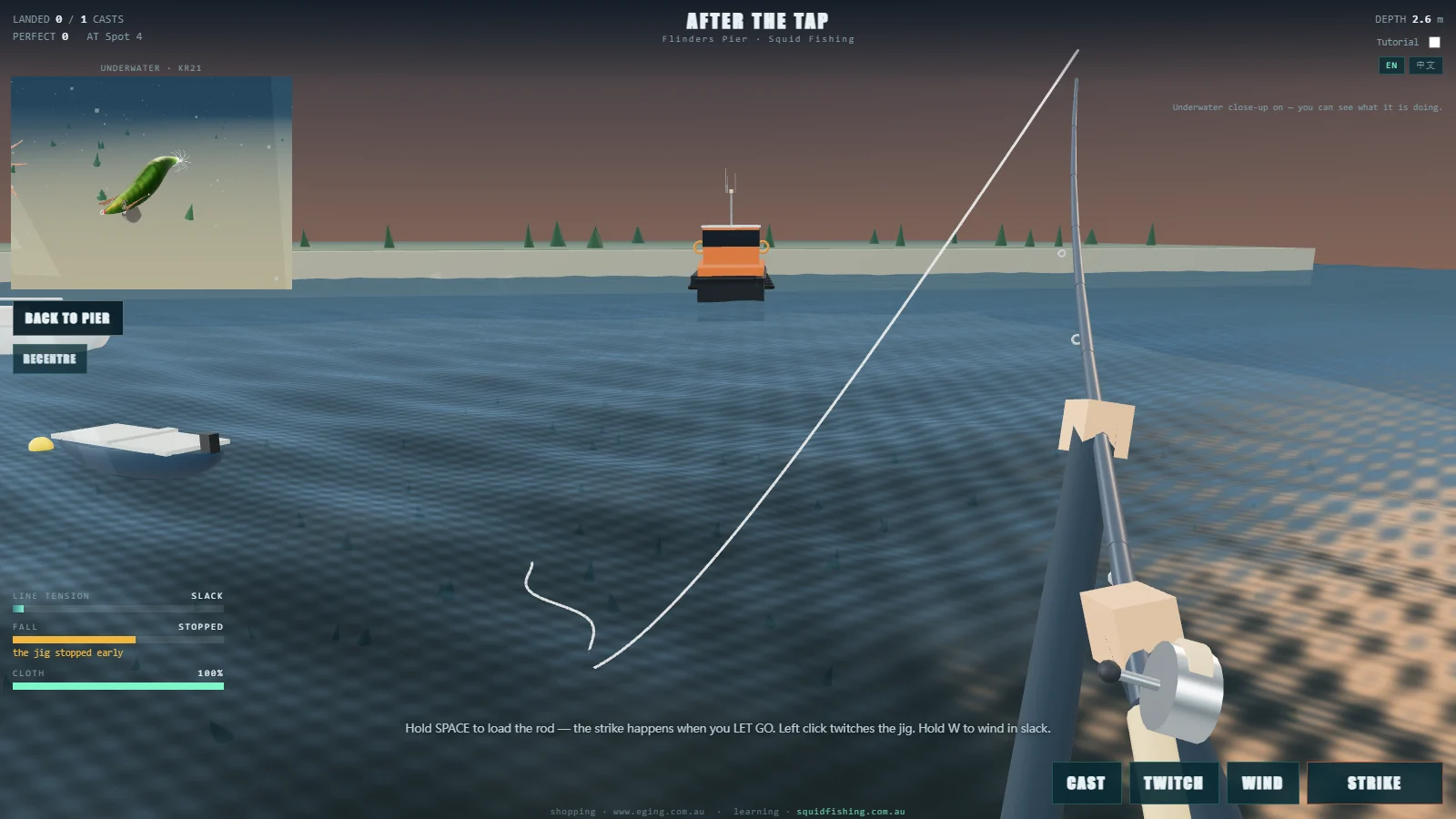
After the Tap: The Game
Same timeline, rod in your hand. Walk out onto a model of Flinders Pier, cast a KR21 and decide when to swing and how hard. Free, in the browser, works on a phone.
Play it →
The three outcomes, side by side
| What the squid does | What the line does | Tension | What to do |
|---|---|---|---|
| It turns and swims away from you它游走 | Comes tight. The bow disappears, the slack hanging in the air pulls straight, and the rod tip is dragged over. | Rises sharply | Strike immediately, firm and upward. |
| It plants itself and does not move它定住不动 | Does not change at all. Same bow, same rod tip. The only thing that changed is that the jig stopped sinking. | Stays flat | Wind down until you are in contact, then lean on it. Weed drags; a squid is heavy, elastic and pulses back. If it is alive, strike hard. |
| It carries the jig back toward you它朝你游 | Goes slacker than it already was on the fall. The bow grows and the rod tip springs back up. | Falls away | Wind down the slack fast until you feel weight, then strike. |
The one signal that survives all three
Tension can rise, stay flat or fall depending on which way the squid turns. In all three cases the fall ended earlier than it should have. That makes the most useful thing you can practise not feeling the line, but knowing roughly how many seconds your jig takes to reach the bottom — because then an early stop is information rather than a guess.
Work out your own numbers with the squid jig sinking rate guide, then read when to strike when squid fishing for the strike itself. The jig in the animation is the RUI REV09.
Questions anglers ask
- What does a squid bite feel like on the line?
- There is no single feel. A squid taps the jig with its two tentacles, which gives one sharp tick with no weight behind it. What happens next depends on which way it swims: away from you and the line comes tight, nowhere and the line does not change, toward you and the line goes slacker than it was on the fall.
- Should I strike as soon as I feel a tap?
- No. A small tap with no weight usually means the squid touched or missed the jig. Striking then pulls the jig away from it. Wait for weight: a heavy, elastic load, or the jig stopping its fall early.
- Why does the line go slack when a squid takes the jig?
- Because the squid is swimming toward you. It removes tension faster than the sinking jig was adding it, so the bow grows and the rod tip unloads. It feels like nothing happened, which is why this take is the one most anglers miss and read as weed.
- What if the line does nothing at all after the tap?
- A big calamari often just anchors. It has the jig, it is not going anywhere, and it is heavy enough that nothing in your hand changes. The signal is not in the line, it is in the clock: the jig stopped sinking early. Wind down into contact and feel for a live, elastic weight before striking.
- Is there one signal that works in all three cases?
- Yes, and only one. Tension can rise, stay flat or fall depending on the direction the squid turns, but in all three the fall ended earlier than it should have. Knowing roughly how many seconds your jig takes to reach the bottom is the single most useful thing you can learn for bite detection.