
Guide
How to Measure a Squid
How to measure a southern calamari the right way — mantle (hood) length, not the tentacle tips — plus realistic size benchmarks.
Every few months someone posts a “metre-long squid” photo. Sometimes it is a beautiful southern calamari. Sometimes it is a genuine trophy. But most of the time, the number comes from the wrong measuring point.
If you measure from the pointed tail of the hood all the way to the stretched tentacle tips, a squid can look enormous. That is not how squid size is normally compared. For southern calamari, the useful measurement is mantle length: the hood or body tube only.
If you are still putting the fishing system together, start with the main eging Australia guide and the best squid jig Australia guide. This page is about judging the squid after it is on the mat.
The one-line answer
Measure the mantle (hood) only: from the pointed rear tip of the body tube to the front edge of the hood between the eyes.
Do not include the head, arms or the two long tentacles.
If you want a number other anglers can actually compare, say something like:
“It was 53 cm mantle.”
Not:
“It was a metre to the tentacle tips.”
Why you don’t measure to the tentacle tips
Southern calamari have eight shorter arms and two long feeding tentacles. Those two tentacles are stretchy. They can extend, relax, curl, shrink, drag behind the squid or get pulled out on a brag mat.
That means a tail-to-tentacle-tip measurement changes depending on how the squid is lying and how much the tentacles are stretched.
It is a good story photo. It is not a good size measurement.
Mantle length is much cleaner because the hood is the solid body of the squid. It is the part that lets you compare one squid with another.
How to measure a squid correctly
You can measure a squid properly in about 30 seconds.
- Lay the squid flat on a ruler, mat or measuring board.
- Straighten the mantle or hood, but do not stretch the tentacles.
- Put the zero mark at the pointed rear tip of the mantle.
- Measure to the front edge of the mantle, near the eyes.
- Ignore the head, arms and tentacles.
- Report the catch as mantle or hood length.
That is the number worth remembering.
See it on a real fish
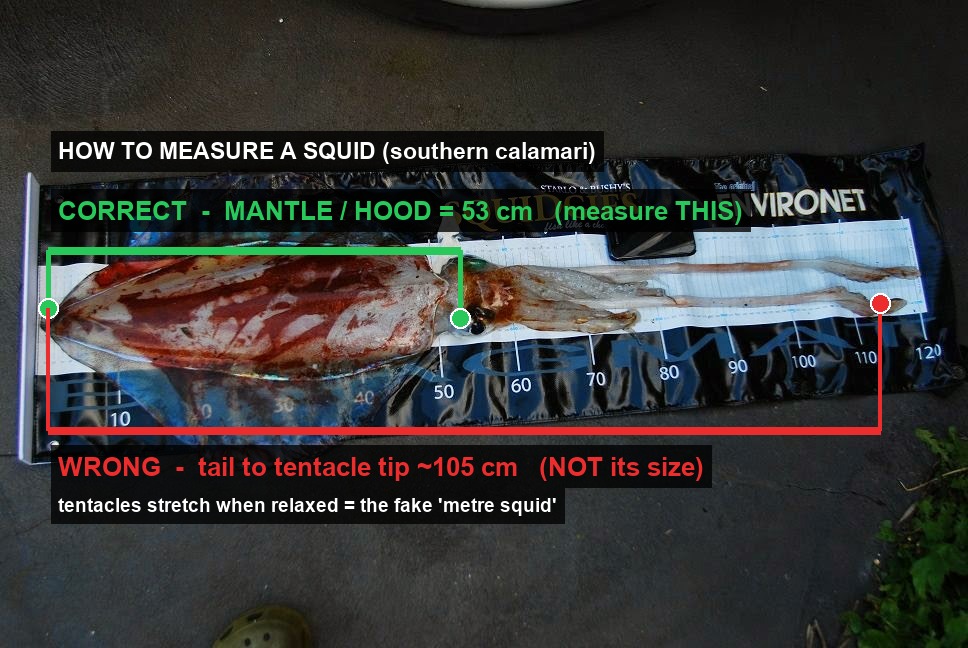
The photo above shows why the mistake happens.
- Green line: mantle length, about 53 cm.
- Red line: tail to tentacle tip, about 105 cm.
It is the same southern calamari. One number is a real size benchmark. The other number explains how “metre-long squid” claims happen.
A 53 cm mantle southern calamari is a serious fish. It does not need the tentacle-tip number to make it impressive.
How big is a squid? Southern calamari size benchmarks
These are practical land-based southern calamari benchmarks, especially for Victorian water. They are not legal size rules; they are a realistic way to talk about fish quality and rarity.
Published records put southern calamari (Sepioteuthis australis) at roughly 40–50 cm maximum mantle length (Museums Victoria; Australian Museum), so a mantle over about 48 cm genuinely sits near the top of the species’ range — a true “metre-long” mantle is outside the known size of the species.
| Mantle length | Practical benchmark |
|---|---|
| Under 15 cm | Very small. I prefer to let these go. |
| 15-25 cm | Good eating-size squid. |
| 25-35 cm | A very solid southern calamari. |
| 35-45 cm | Big squid. Worth a photo. |
| 48 cm+ | Rare trophy territory. |
| 50 cm+ | Exceptional. Most anglers will not see many. |
When someone says “metre-long southern calamari”, ask which measurement they used. A squid can be around a metre from tail to stretched tentacle tips while still being roughly a 50 cm mantle fish.
That is not small. It is just a different measurement.
So, is your squid a metre?
If the squid is a metre from the pointed tail to the end of the two long tentacles, it is probably not a metre-long squid in the useful sense.
It is better to say:
“It measured about a metre overall, but around 50 cm mantle.”
That sentence is honest, impressive and useful.
If someone claims a true metre southern calamari by mantle length, that is a very different claim. For normal Australian southern calamari fishing, the number that matters is the mantle.
Reporting your catch and the rules
Size measurement and fishing rules are separate things.
For Victorian waters, VFA currently lists squid, calamari, octopus and cuttlefish with no minimum legal size and a combined total limit of 10. Always confirm the current rule on the official VFA squid, octopus and cuttlefish rules page before keeping a catch.
No minimum legal size does not mean every tiny squid is worth keeping. Releasing very small squid, especially sub-15 cm mantle fish, is good practice.
For other states and territories, start with the squid legal size and regulations Australia guide and then open the official source for the water you are fishing.
Landing a big one cleanly matters before you ever put it on a mat. If you regularly fish higher piers or rock edges, browse squid gaffs Australia before trying to lift heavy calamari by line.
FAQ
How do you measure a squid or calamari?
Measure the mantle or hood only. Start at the pointed rear tip of the mantle and measure to the front edge of the mantle between the eyes. Do not include the head, arms or tentacles.
Can a southern calamari really be a metre long?
It can measure around a metre from tail to stretched tentacle tips, but that is not the normal size benchmark. Mantle length is the proper comparison. Around 48 cm plus mantle is already a rare trophy.
Why don’t you count the tentacles?
The long feeding tentacles stretch and relax, so the number changes depending on how the squid is lying on the mat. Mantle length is repeatable.
What is a good size squid to keep?
For eating, roughly 15-25 cm mantle is a nice size and 25-35 cm is a very good fish. I prefer to release very small squid. Check the rules before keeping any catch.
How big is a squid?
For southern calamari, size is judged by mantle (hood) length, not the tentacle tips. Roughly 15-25 cm mantle is a good eating size, 25-35 cm is a very good fish, and 48 cm plus mantle is rare trophy territory.