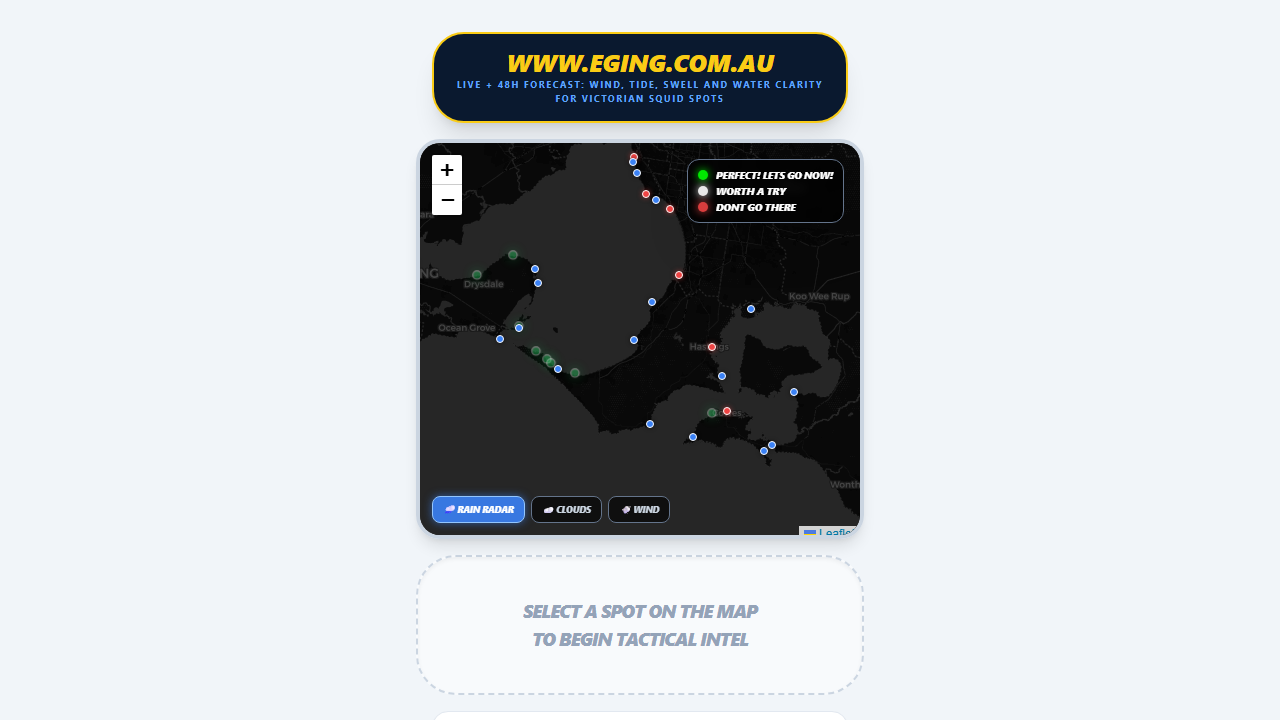
Check Victorian Squid Radar
Compare wind, tide, swell, rain and water-clarity signals across Victorian spots. Decide where the safest, most fishable session is likely to be before you drive.
Two-page printable session planner
Plan in the right order: use Radar to choose where to fish, calculate the jig size for that location, then choose colour from the water and light you actually find when you arrive.
Field Kit reader offer: 10% off your first RUI order
Use code FIELDKIT10 at checkout, or use the button below to apply it automatically.
Apply 10% and shop RUI jigsOne session, three decisions
Compare wind, tide, swell, rain and water-clarity signals across Victorian spots. Decide where the safest, most fishable session is likely to be before you drive.
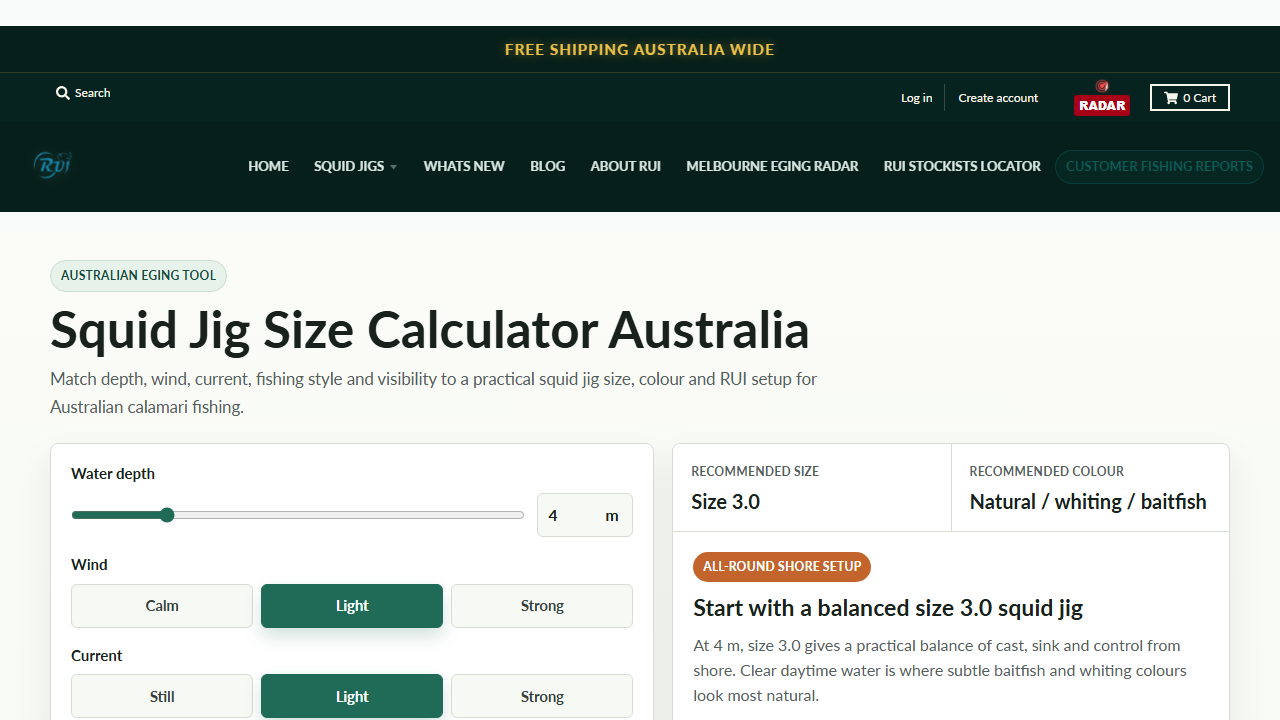
Use the expected depth, wind, current and casting distance at that location. Choose the lightest jig that should still reach the zone and keep the line under control.
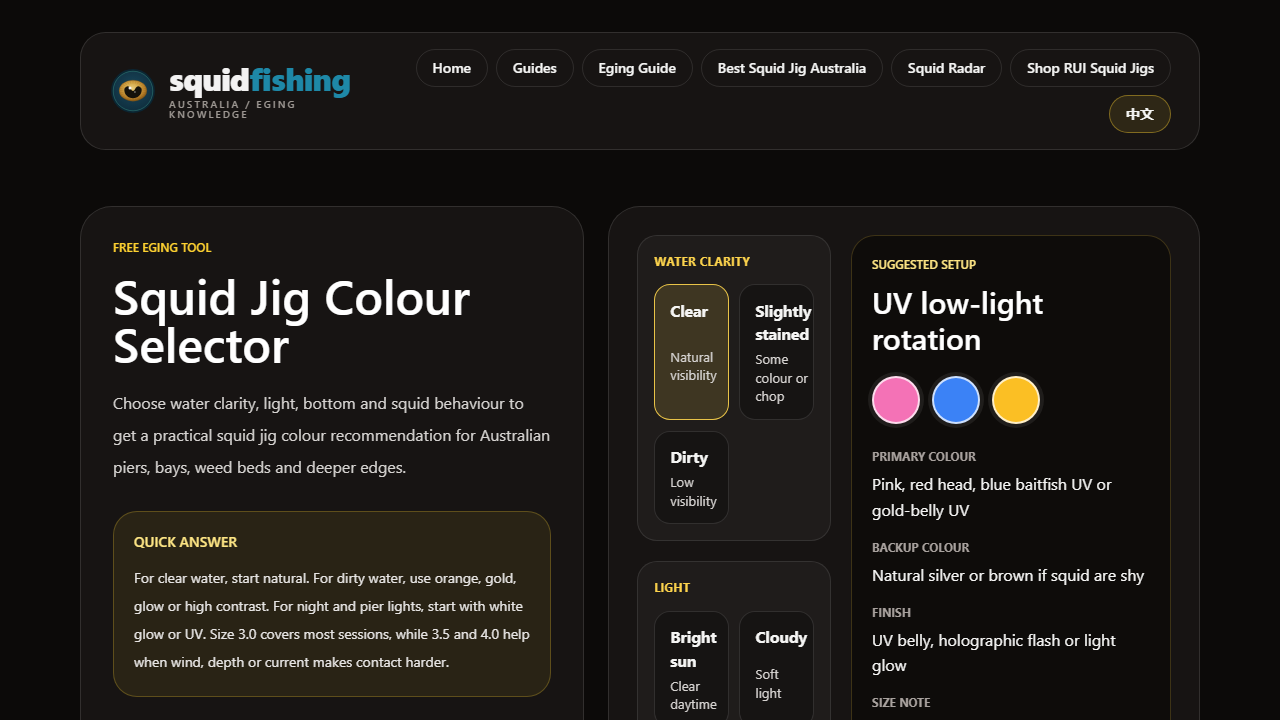
Look at the actual water clarity, light, bottom and squid behaviour. Weather forecasts help you plan, but the colour decision should use the water you can see in front of you.
At the water
Plan the session in the right order
Where to fish, what size to use, then what colour to start
Before choosing a destination
Compare wind, tide, swell, rain and water-clarity signals across Victorian spots. Decide where the safest, most fishable session is likely to be before you drive.
DecisionWhere and when to fish
radar.eging.com.au After selecting the spot
Use the expected depth, wind, current and casting distance at that location. Choose the lightest jig that should still reach the zone and keep the line under control.
DecisionWhich jig size goes on first
3.5 Slow Sinking: 19g, about 5.5 s/m. Full 3.5 silhouette with more hang time. RUI option
eging.com.au/pages/squid-jig-size-calculator-australia At the water, before the first cast
Look at the actual water clarity, light, bottom and squid behaviour. Weather forecasts help you plan, but the colour decision should use the water you can see in front of you.
DecisionThe first colour and backup rotation
squidfishing.com.au/tools/squid-jig-colour-selectorOn-water quick reference
Recheck conditions, control the jig, then work the rotation
Shallow, calm water and cautious squid
Move upWind or current stops a clean sink
Normal all-round shore starting size
Move upYou cannot feel depth or control line belly
19g, about 5.5 s/m. Full 3.5 profile over shallow weed or suspended squid
Move upUse standard 3.5 when wind or current prevents line control
20g, about 3.0-3.2 s/m. Wind, current and deeper edges
Move upUse Slow Sinking when the full profile drops too quickly
Deep edges, strong current and deliberate long casts
Move upOnly when the location and tackle support it
Clear water, bright sun
Dark natural tones or a low-flash profile
BackupKeep a natural baitfish option; compare silhouette with flash
Clear water, squid only following
Soft pink or muted contrast
BackupDownsize or slow the retrieve
Dirty water, cloud or wind chop
Orange, gold, red foil or contrast
BackupAdd glow or a dark silhouette
Dawn, dusk, night or pier lights
Glow, UV or dark-backed glow
BackupRotate one natural option through light
Bag, possession and area rules can change. Check the official authority before fishing. Use the Australian squid fishing regulations guide for current official links.
Free downloads / Australian eging
Take a chart to the water, add it to a club handout or use it in your next fishing article. Download a sharp image or an A4 PDF, and copy the source credit when you share it.
Download all 4 charts - PDF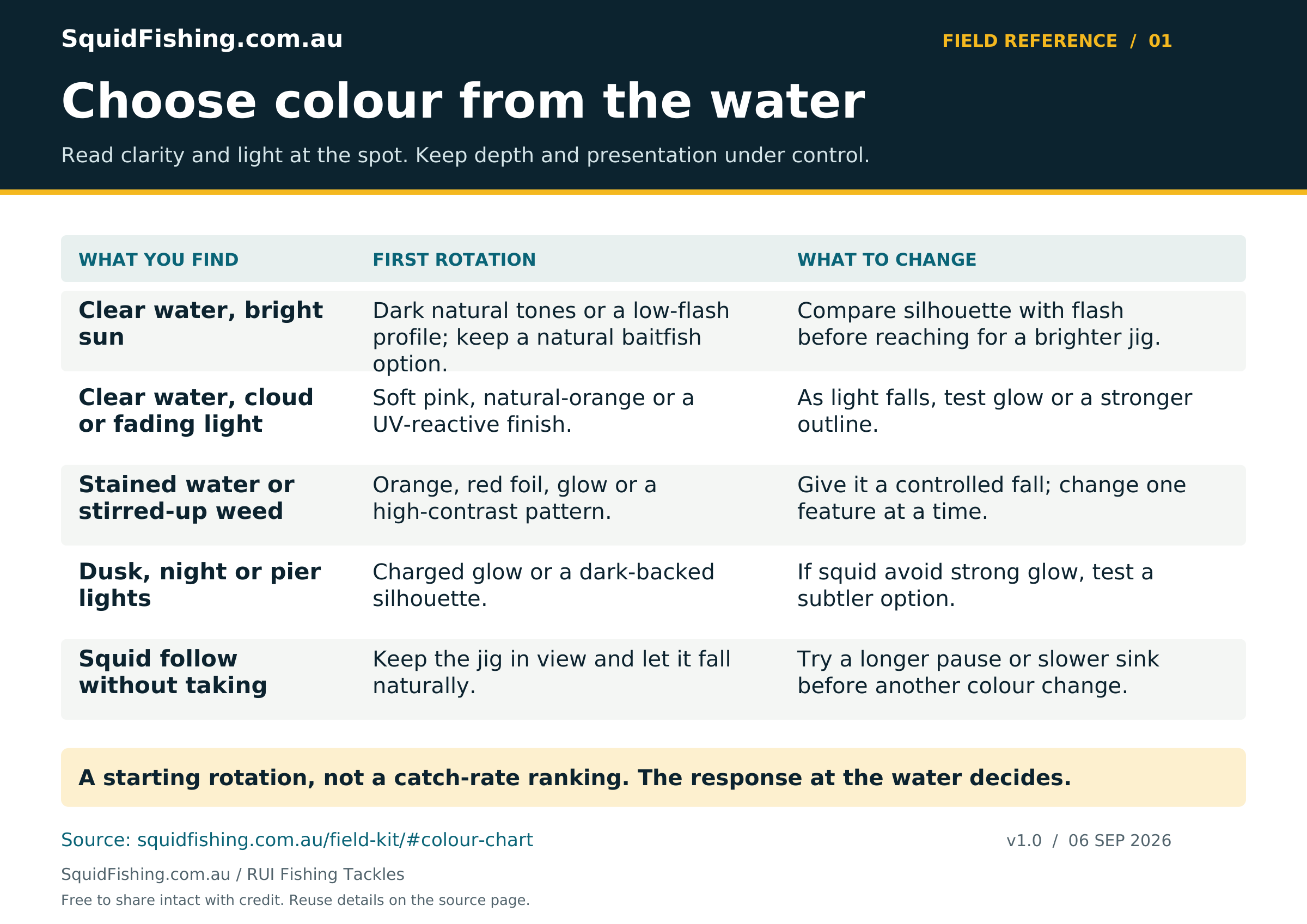
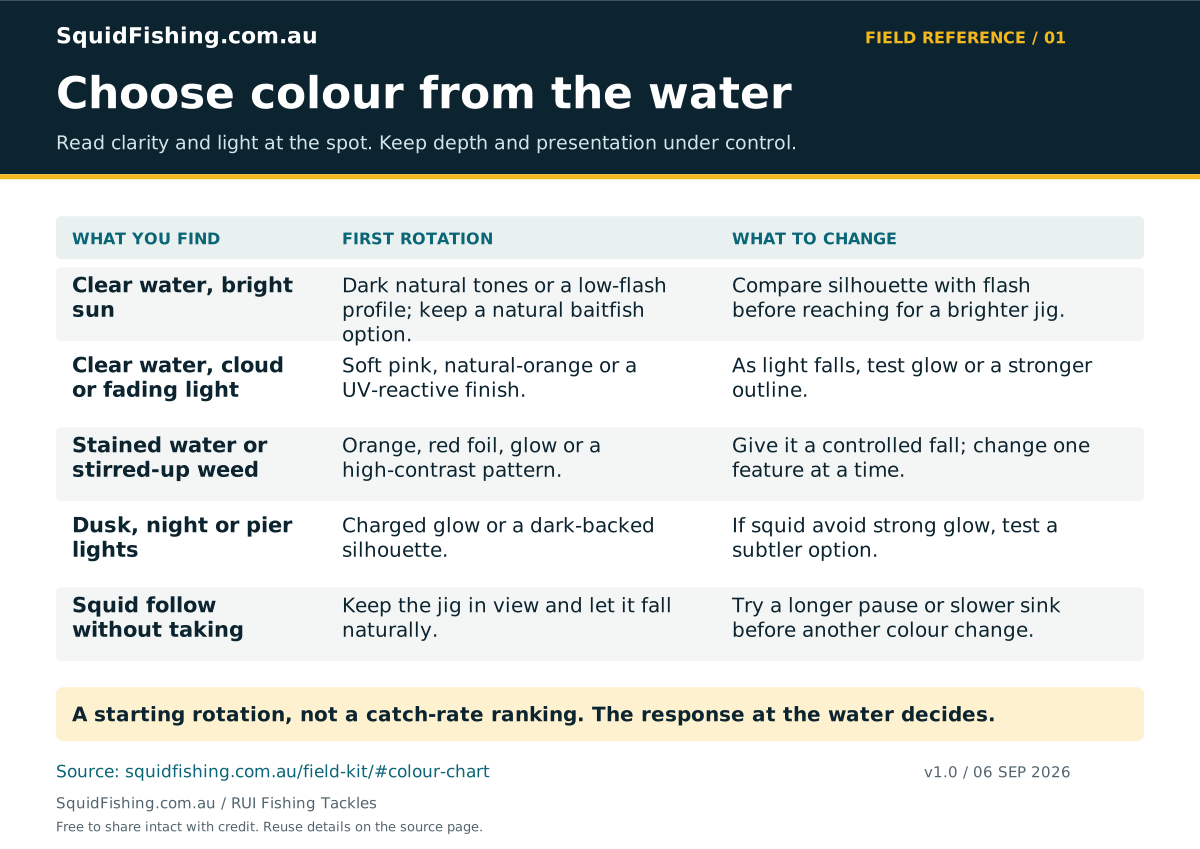
Read clarity and light at the spot. Keep depth and presentation under control.
| What You Find | First Rotation | What To Change |
|---|---|---|
| Clear water, bright sun | Dark natural tones or a low-flash profile; keep a natural baitfish option. | Compare silhouette with flash before reaching for a brighter jig. |
| Clear water, cloud or fading light | Soft pink, natural-orange or a UV-reactive finish. | As light falls, test glow or a stronger outline. |
| Stained water or stirred-up weed | Orange, red foil, glow or a high-contrast pattern. | Give it a controlled fall; change one feature at a time. |
| Dusk, night or pier lights | Charged glow or a dark-backed silhouette. | If squid avoid strong glow, test a subtler option. |
| Squid follow without taking | Keep the jig in view and let it fall naturally. | Try a longer pause or slower sink before another colour change. |
A starting rotation, not a catch-rate ranking. The response at the water decides.
Link to this chart's source so readers can find the notes and current version.
The clear-sun row also incorporates Rui's supplied field advice to test dark colours in clear, sunny conditions. This is practical angling guidance, not a controlled comparison.
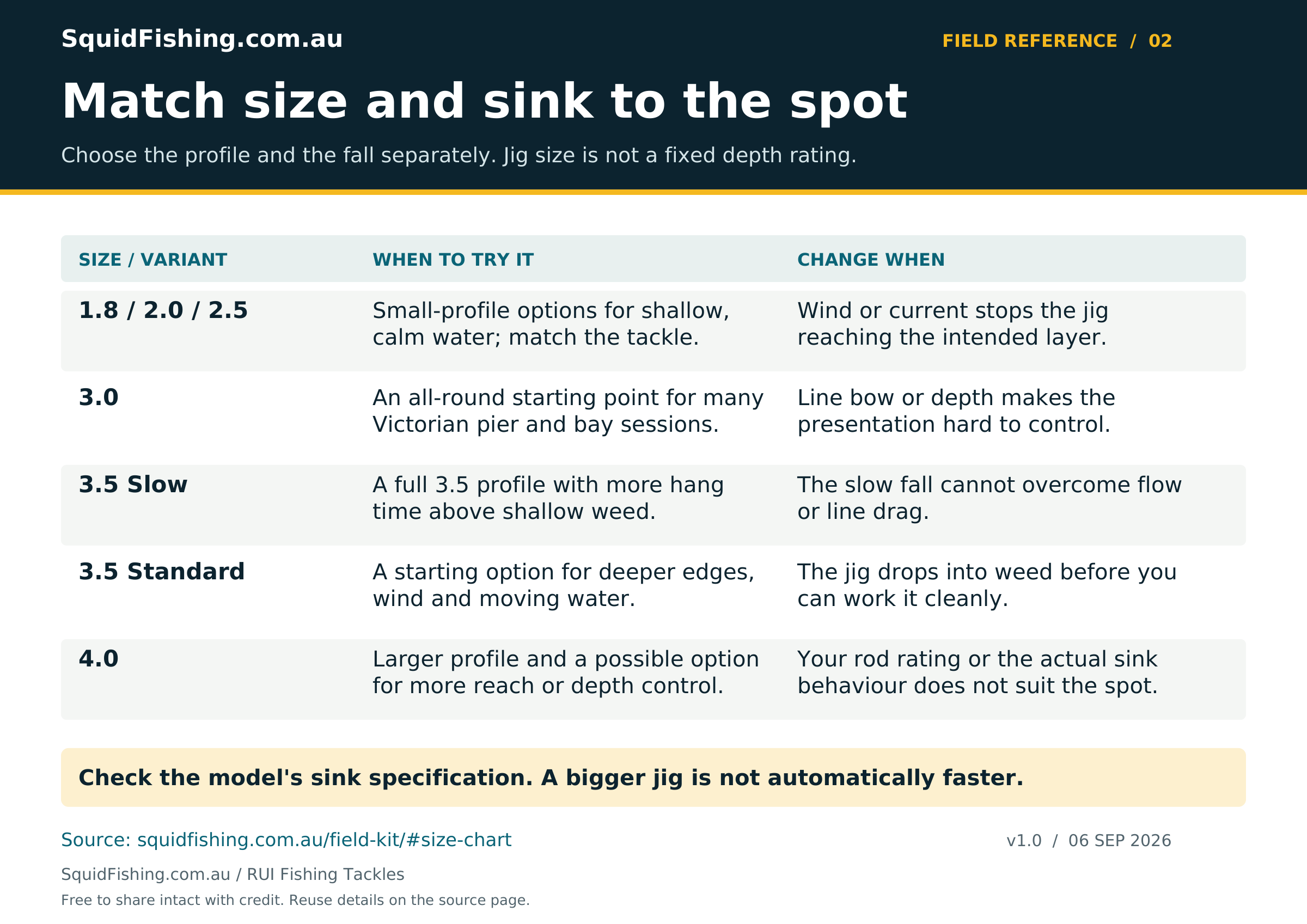
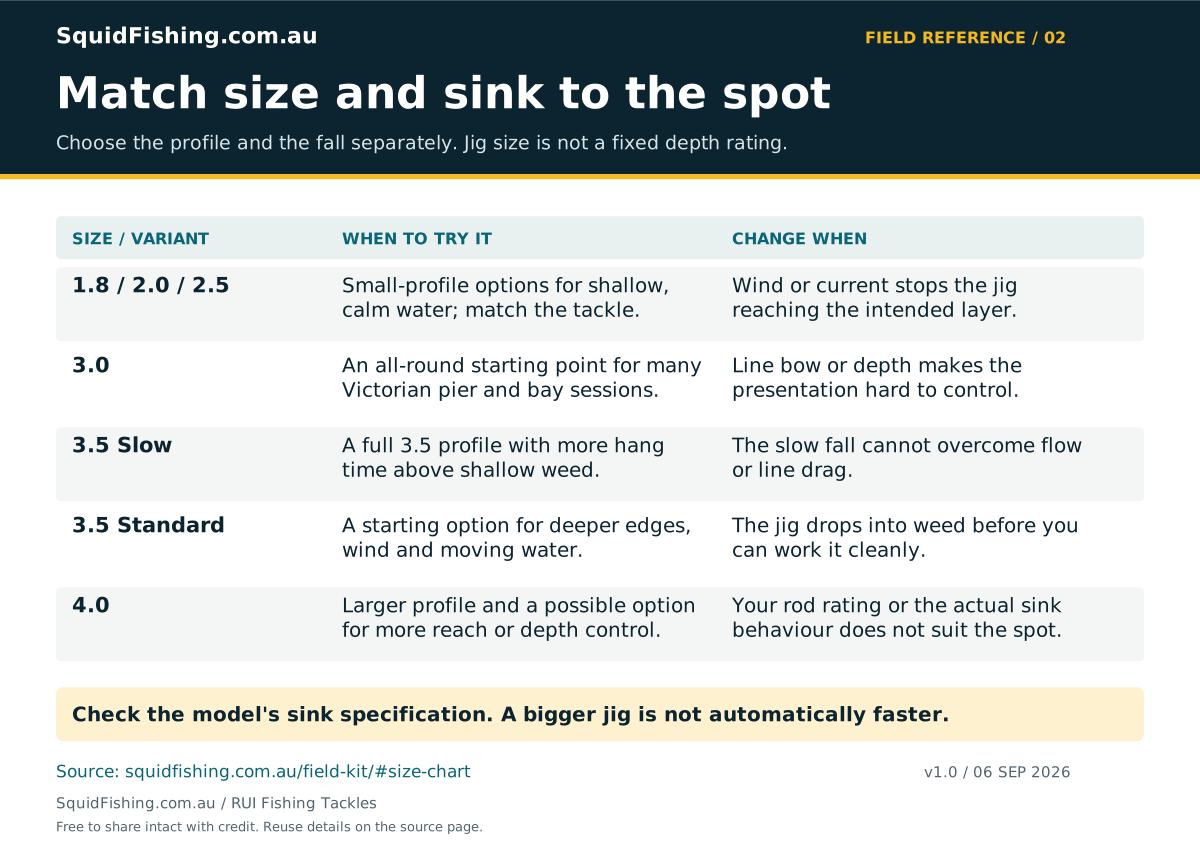
Choose the profile and the fall separately. Jig size is not a fixed depth rating.
| Size / Variant | When To Try It | Change When |
|---|---|---|
| 1.8 / 2.0 / 2.5 | Small-profile options for shallow, calm water; match the tackle. | Wind or current stops the jig reaching the intended layer. |
| 3.0 | An all-round starting point for many Victorian pier and bay sessions. | Line bow or depth makes the presentation hard to control. |
| 3.5 Slow | A full 3.5 profile with more hang time above shallow weed. | The slow fall cannot overcome flow or line drag. |
| 3.5 Standard | A starting option for deeper edges, wind and moving water. | The jig drops into weed before you can work it cleanly. |
| 4.0 | Larger profile and a possible option for more reach or depth control. | Your rod rating or the actual sink behaviour does not suit the spot. |
Check the model's sink specification. A bigger jig is not automatically faster.
Link to this chart's source so readers can find the notes and current version.
General selection guidance. Weights and seconds-per-metre are deliberately omitted because they vary by model and conditions. Slow is a sink-rate variant, not another size.
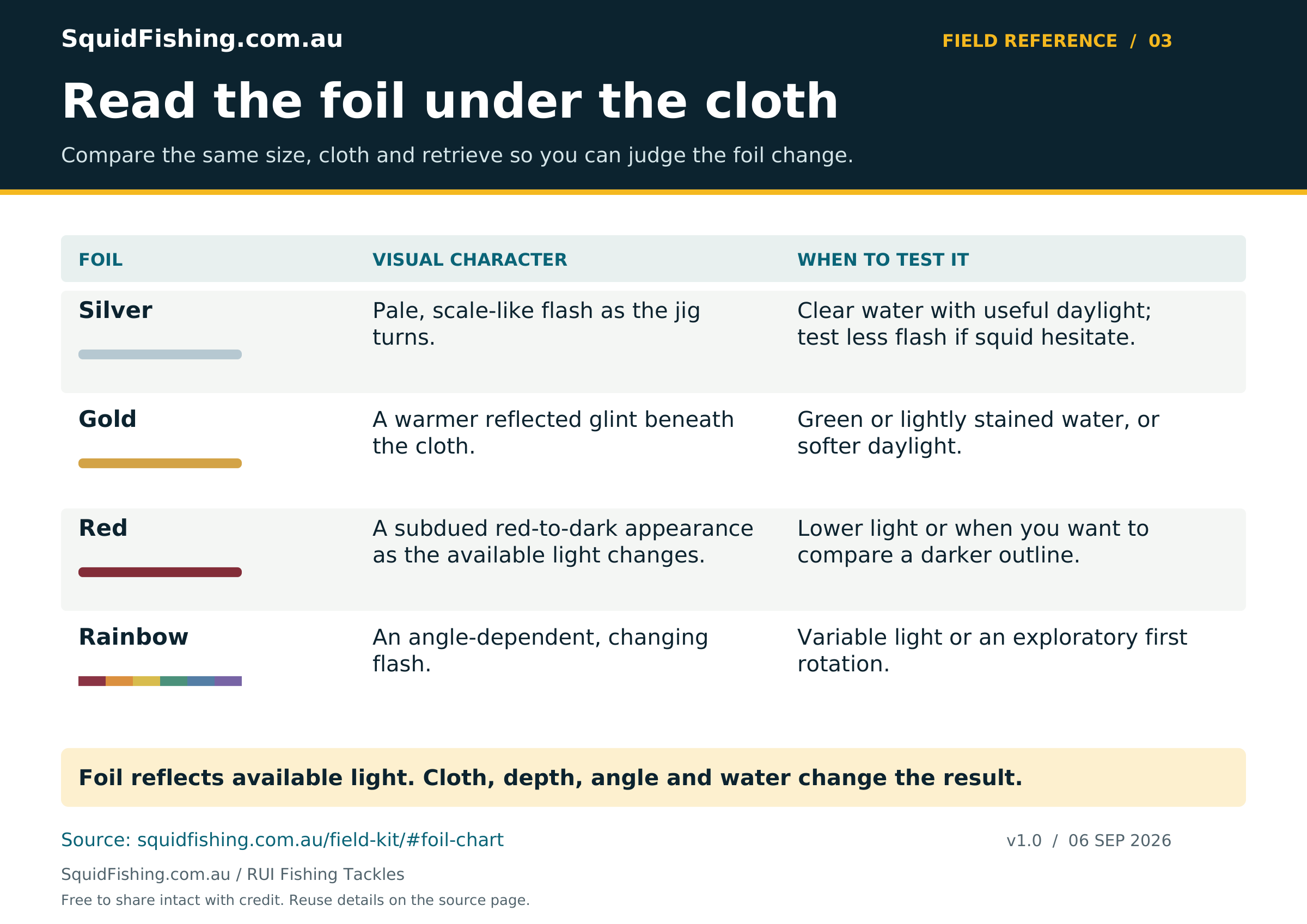
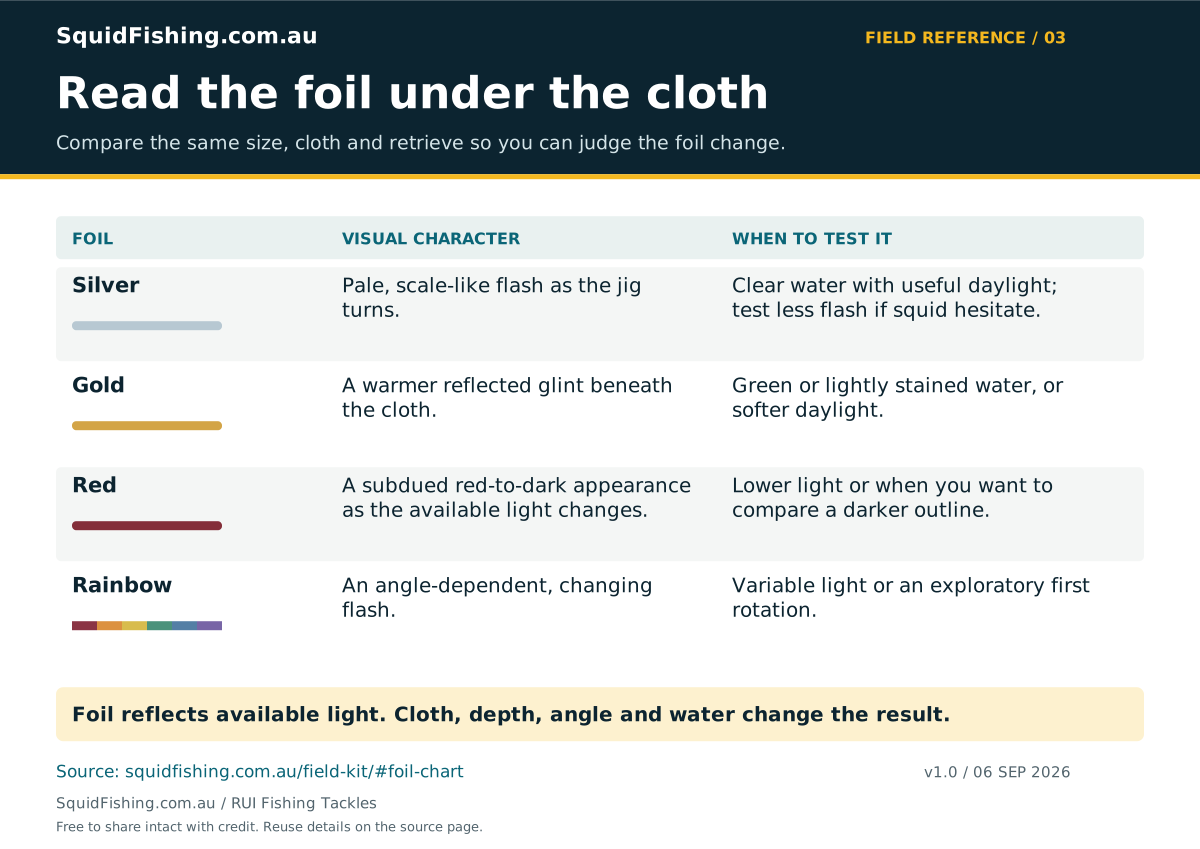
Compare the same size, cloth and retrieve so you can judge the foil change.
| Foil | Visual Character | When To Test It |
|---|---|---|
| Silver | Pale, scale-like flash as the jig turns. | Clear water with useful daylight; test less flash if squid hesitate. |
| Gold | A warmer reflected glint beneath the cloth. | Green or lightly stained water, or softer daylight. |
| Red | A subdued red-to-dark appearance as the available light changes. | Lower light or when you want to compare a darker outline. |
| Rainbow | An angle-dependent, changing flash. | Variable light or an exploratory first rotation. |
Foil reflects available light. Cloth, depth, angle and water change the result.
Link to this chart's source so readers can find the notes and current version.
Colours describe an angler-visible reference, not a reconstruction of squid colour vision. These are qualitative starting points; no performance scores or universal depth cut-offs are claimed.
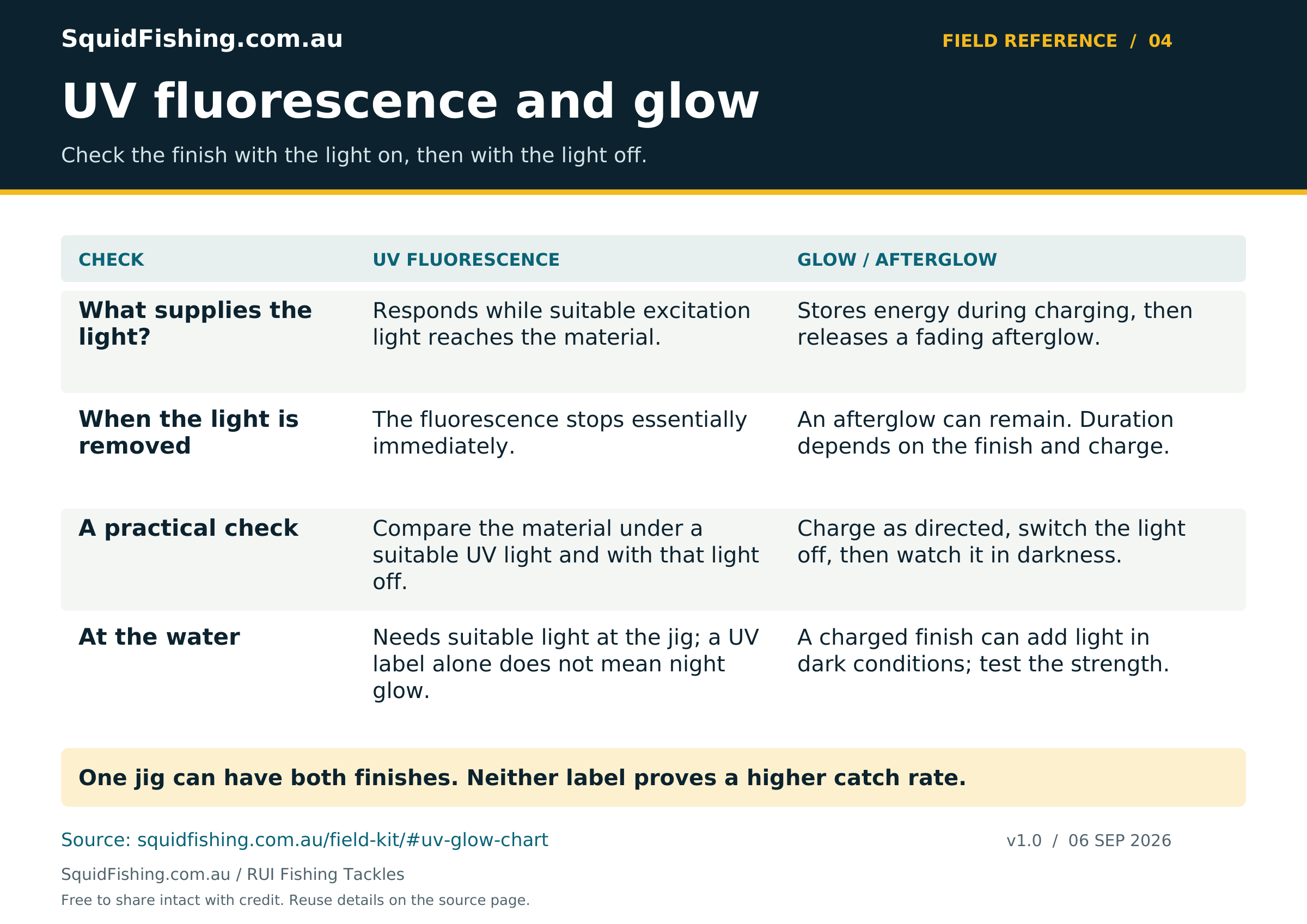
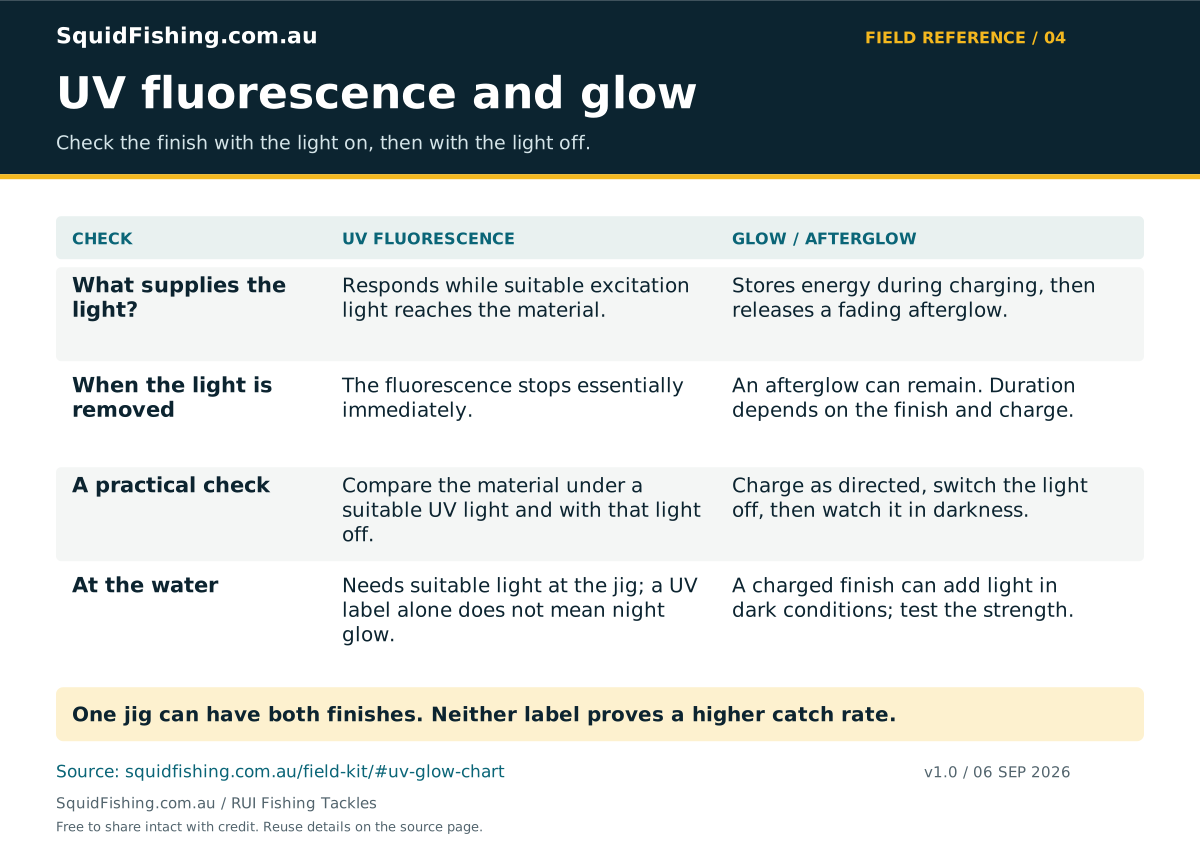
Check the finish with the light on, then with the light off.
| Check | Uv Fluorescence | Glow / Afterglow |
|---|---|---|
| What supplies the light? | Responds while suitable excitation light reaches the material. | Stores energy during charging, then releases a fading afterglow. |
| When the light is removed | The fluorescence stops essentially immediately. | An afterglow can remain. Duration depends on the finish and charge. |
| A practical check | Compare the material under a suitable UV light and with that light off. | Charge as directed, switch the light off, then watch it in darkness. |
| At the water | Needs suitable light at the jig; a UV label alone does not mean night glow. | A charged finish can add light in dark conditions; test the strength. |
One jig can have both finishes. Neither label proves a higher catch rate.
Link to this chart's source so readers can find the notes and current version.
UV here means a UV-fluorescent finish, not every product marketed as UV and not UV reflection. The chart does not claim that squid see ultraviolet. Follow the lamp maker's eye-safety instructions.
You may copy, print, share and republish these four charts free of charge, including in fishing-club handouts, articles and commercial fishing websites. Keep the chart content, source and branding intact; resizing without cropping is welcome.
Credit SquidFishing.com.au / RUI Fishing Tackles. When sharing online, please link to the relevant chart above so readers can find the full explanation and current version. You may qualify that link with nofollow or another appropriate link attribute. No reciprocal link or endorsement is required.
This permission covers these four charts only. It does not extend to other site photographs, customer images or logos used separately. For translations or changes to the chart content, ask before publishing an altered version.
Put it on your site
Free to share, print and hand out. Running a fishing club, blog or tackle shop? Paste this to put the two-page kit on your site — it links back so your readers always get the latest version.